Light-emitting diodes — better known as LEDs — have quietly taken over the lighting aisle. More suppliers stock them, more manufacturers build around them, and more homeowners and business owners across Northern New Jersey are making the switch every year. So what actually makes these bulbs worth the change? At J. Christie Electrical Contractor LLC, we install LED lighting for residential and commercial clients every week, and the benefits of switching to LED lighting come down to a few things you’ll notice on your energy bill, in your safety, and in how often you’re stuck on a ladder swapping bulbs.
Here’s a closer look at why LEDs have become the standard — and how a properly planned upgrade pays you back.
Lower Energy Bills, Every Month
LEDs are, by a wide margin, the most efficient lighting option available to consumers today. According to the U.S. Department of Energy, residential LEDs — especially ENERGY STAR rated products — use at least 75% less energy than traditional incandescent bulbs. In rooms where lights run for hours at a time, that difference adds up fast.
Part of the savings comes from how LEDs aim light. Incandescent and CFL bulbs throw light in every direction, so recessed downlights and task fixtures need reflectors and diffusers to push it where you actually want it. Even then, up to half of that light can stay trapped inside the fixture. LEDs are naturally directional — they send light exactly where it’s needed, which means you get the same brightness from less wattage. For NJ kitchens, home offices, basements, and retail floors where lighting is on all day, that’s the single biggest reason homeowners and businesses ask us for an LED upgrade.
They Run Cool — and Safer
This is the benefit most people don’t think about until we point it out. An incandescent bulb releases roughly 90% of its energy as heat, and a CFL still gives off about 80% as heat. Leave those on for a while and they get hot enough to burn a hand or, in the wrong spot, become a fire risk.
LEDs emit very little heat. Even after running for hours, an LED bulb stays cool enough to touch safely. That makes them a smart choice for fixtures within reach — desk lamps, bedside lights, closets, and tight enclosed spaces — and it’s a meaningful safety upgrade in older Northern NJ homes where lighting sits close to wood, fabric, or insulation. If lighting safety is on your mind, our residential electrical services team can evaluate your existing fixtures during an upgrade.
A Lifespan That Outlasts Everything Else
Quality LED bulbs don’t really “burn out” the way a filament bulb does. Instead, they gradually dim over a very long working life. The Department of Energy notes that a good LED bulb can last up to 25 times longer than an incandescent and 3 to 5 times longer than a CFL. Here’s how the common bulb types stack up:
|
Bulb Type |
Typical Lifespan (hours) |
Energy Lost as Heat |
|
Incandescent |
~1,000 |
~90% |
|
Halogen |
~2,000 |
High |
|
CFL |
8,000 – 20,000 |
~80% |
|
Fluorescent |
15,000 – 20,000 |
Moderate |
|
LED |
Up to 50,000 |
Very low |
Because LEDs are mounted on a circuit board instead of relying on a fragile filament and thin glass, they also shrug off vibration and minor bumps far better than older bulbs. Fewer replacements means lower maintenance — less money spent on bulbs and less labor spent changing them, which is exactly why commercial properties with high ceilings or large fixture counts see the upgrade pay for itself.
Better Light Quality and More Control
Efficiency would mean little if the light looked bad — but modern LEDs deliver. They typically carry a high Color Rendering Index (CRI), meaning colors look true and natural under them, and they come in a range of color temperatures, from warm and cozy to crisp daylight. You can match the mood of a bedroom, the focus of a workspace, or the clean look of a retail display, all without sacrificing efficiency.
LEDs also pair beautifully with dimmers and smart controls. You can set outdoor lights to dim on a schedule, program commercial lighting to switch on before opening, or tie everything into a smart-home system — all of which trims energy use even further. When we design commercial electrical services for offices and storefronts, LED plus controls is almost always where the biggest long-term savings live.
Where LEDs Make the Biggest Difference in Your Home
LED technology now covers nearly every fixture you have, so an upgrade rarely means compromise. A few of the spots where our customers notice the change most:
- Recessed downlights in kitchens, hallways, and bathrooms — directional and efficient by design
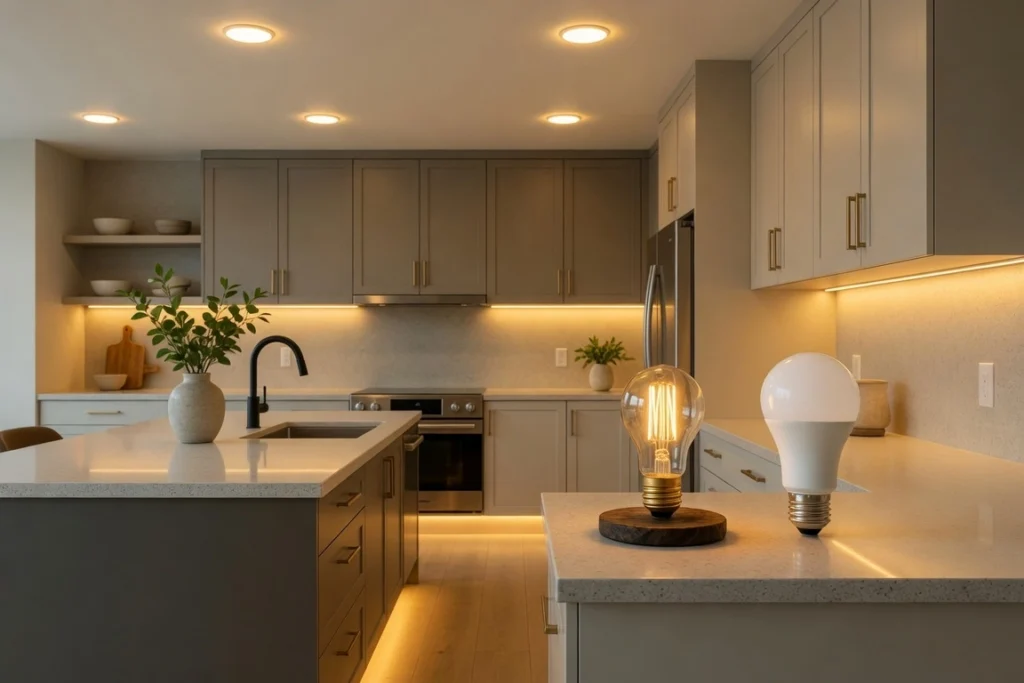
- Under-cabinet lighting for countertops and work areas, where the small size of LEDs shines
- Outdoor and security lighting, which runs longer and stands up to weather better
- Holiday light strings, which run cooler, resist breakage, and can be linked end-to-end without overloading an outlet
If you’re upgrading fixtures or whole rooms, our electrical lighting specialists handle the layout, wiring, and installation so the result is even, code-compliant, and built to last.
An Eco-Friendly Choice, Too
Beyond the bill savings, LEDs are free of the toxic mercury found in CFLs, which makes disposal simpler and the bulbs more environmentally friendly. Lower energy use also means a smaller carbon footprint over the life of every fixture — a benefit that scales up quickly across a full home or a commercial building.
Upgrade to LED Lighting with J. Christie Electric
For most Northern NJ homes and businesses, switching to LED lighting is one of the highest-return electrical upgrades you can make — lower bills, safer operation, and years between replacements. The key is having it installed and matched correctly, from choosing the right brightness and color temperature to wiring dimmers and controls the right way.
- Christie Electrical Contractor LLC has served Northern New Jersey for 20+ years, fully licensed (NJ Electrical Contractor #17914), bonded, and insured. Whether you want to convert a single room or re-light an entire property, we’ll get it done right the first time. Call (201) 310-5402 and ask for Jason, or contact us for a free assessment.
Frequently Asked Questions
Are LED bulbs really worth the higher upfront cost?
Yes. LEDs cost more per bulb but use far less energy and last up to 50,000 hours, so lower bills and fewer replacements typically outweigh the initial price over time.
Can I just swap my old bulbs for LEDs myself?
Many standard bulbs are a simple swap, but recessed fixtures, dimmers, and whole-room upgrades often need proper wiring and the right dimmer to avoid flicker. A licensed electrician ensures it’s safe and code-compliant.
Do LED lights work with dimmer switches?
They can, but only with LED-compatible dimmers. Pairing LEDs with the wrong dimmer is a common cause of buzzing or flickering, which is why correct installation matters.
Will switching to LED lower my electric bill in New Jersey?
For most homes and businesses, yes — especially in rooms where lights run for long stretches, since ENERGY STAR LEDs use at least 75% less energy than incandescent bulbs.
Do LEDs last longer than CFLs?
Yes. A quality LED bulb lasts roughly 3 to 5 times longer than a CFL and up to 25 times longer than an incandescent bulb.