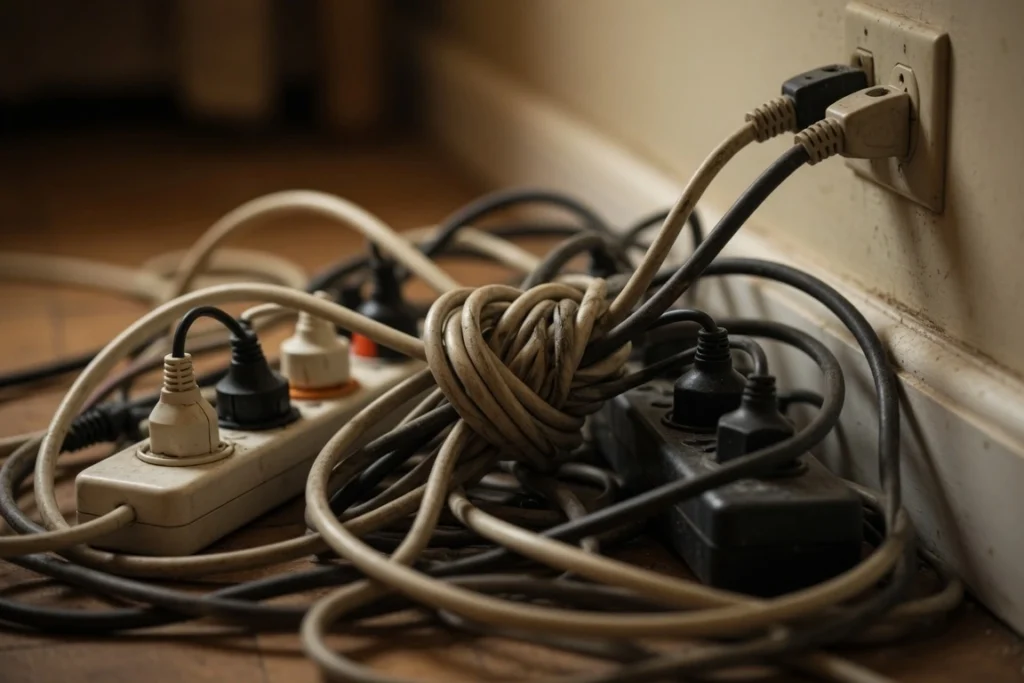
Extension cords are one of the most commonly used tools in every home — from plugging in a lamp across the room to running power to your garage. Yet most Northern New Jersey homeowners never give them a second thought at the store. They grab whatever is cheapest and the right length, and call it a day.
That approach can be dangerous. At J. Christie Electrical Contractor LLC, we’ve seen firsthand what happens when the wrong extension cord meets the wrong device. A little knowledge upfront can save you from a tripped breaker — or worse, an electrical fire.
Here are the most common mistakes to avoid when buying and using extension cords.
Don’t Exceed the Cord’s Wattage Rating
Every extension cord has a wattage and amperage limit printed on its packaging or tag. Exceeding that limit is one of the leading causes of cord overheating. A typical budget cord uses 16-gauge internal wiring, rated for around 10 amps. A standard 1,500-watt space heater alone draws 12.5 amps — already past the limit.
When in doubt, plug high-draw appliances like space heaters, refrigerators, or air conditioners directly into a wall outlet. And if your breakers are frequently tripping, it may be time for an electrical panel evaluation before things get worse.
Never String Two Extension Cords Together
It’s tempting to connect two shorter cords to reach a distant outlet, but this creates a real hazard. Daisy-chaining extension cords increases resistance along the line, which leads to overheating and potential fire risk. If you need a longer reach, invest in a single cord of the correct length.
Watch Where You Route the Cord
Running a cord through high-traffic areas is a trip hazard — and constant foot traffic also wears down the insulation over time, exposing the wiring inside. If a cord must cross a walkway, use a cord cover or route it along the baseboard. Better yet, call a licensed electrician in Northern NJ to have a new outlet installed where you actually need it.
Don’t Use Extension Cords as Permanent Wiring
This is more common than you’d think, especially in commercial settings. We’ve seen businesses in Bergen County and Passaic County running extension cords to ceiling-mounted projectors and other equipment for months or years. This is a code violation and a fire hazard. Permanent installations need proper receptacles — a job for a licensed NJ electrical contractor.
Don’t Overload the Outlets on the Cord
An extension cord with multiple outlets is not an invitation to plug in everything you own. Treat it the same way you’d treat a standard wall outlet — two low-draw devices at most. Never add a second device if the first is already drawing heavy power.
Use the Right Gauge for the Job
Extension cord gauge is marked as an AWG (American Wire Gauge) number — commonly #12, #14, or #16. Here’s the counterintuitive part: the higher the number, the thinner the wire, and the less power it can safely carry.
For short, light-duty use like a lamp or phone charger, a 16-gauge cord is fine. For power tools, appliances, or longer runs, step up to a 14-gauge or 12-gauge cord. Using an undersized wire gauge causes the cord to heat up, which can melt the outlet end and damage connected devices. According to the National Fire Protection Association (NFPA), electrical fires from misused cords and plugs cause hundreds of home fires across the U.S. every year.
Extension Cords Are a Temporary Fix — Not a Permanent Solution
If you find yourself relying on extension cords in the same spots around your home or business day after day, that’s a sign your electrical system needs more outlets. At J. Christie Electrical Contractor LLC, we regularly help homeowners and businesses throughout Northern New Jersey — from Paramus to Clifton to Montclair — add outlets exactly where they’re needed, safely and up to NJ electrical code.
Have questions about your home’s electrical setup? Give us a call at (201) 310-5402 or request a free assessment online. No job is too big or too small.